
 Workshop
If This, Then What?
A tangible logic-builder for exploring automated services
Workshop Creators:
Institute for Design Informatics: Bettina Nissen • Chris Elsden • Ella Tallyn | TU Delft Dave Murray-Rust
Workshop Overview
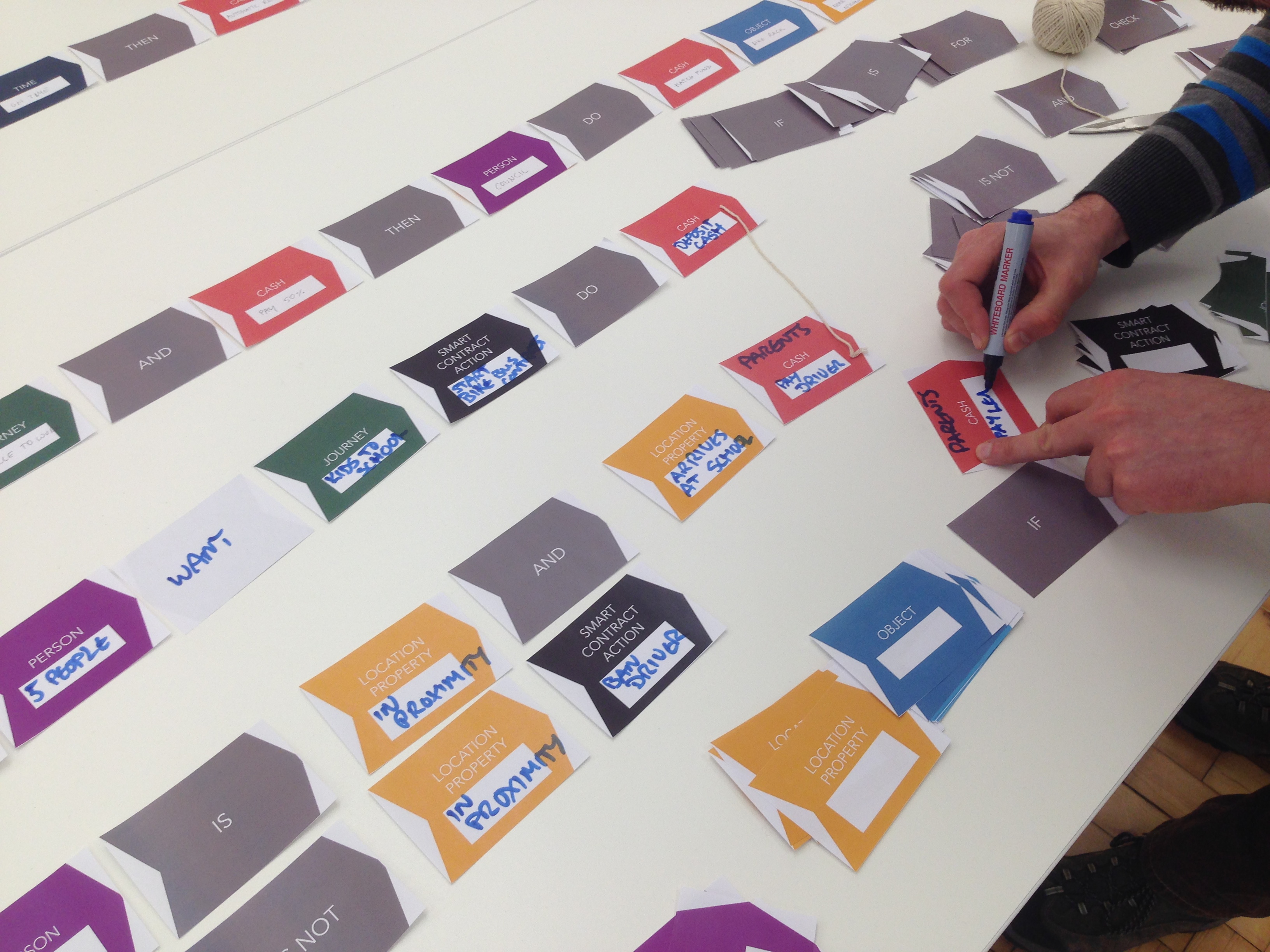
If This, Then What? (IFTTW?) is a flexible design card deck used to explore and develop the logic of automated services. Unlike other Playbook workshops that follow a fixed path, This card deck presents an open ended set of possible activities and is designed to help teams prototype the "mechanics" of a smart contract.
By breaking processes into granular "if/then" flows, participants move from high-level speculation to a grounded Logic Blueprint. This process helps teams evaluate if a project is ready for automation or if the real-world context is still too "messy" for code to handle.
Use the card deck to:
- Audit Data Requirements: Identify where trusted data sources (Oracles) are needed.
- Test the "Handbrake": Decide where human intervention is required versus where code can run independently.
- Identify Templates: Design repeatable patterns for transactions like escrows, licensing, or insurance.
More About This Workshop
The concept of a "smart contract" was first proposed in the 1990s by computer scientist Nick Szabo, long before the arrival of blockchain. He described them as "digital vending machines"—automated agreements that execute themselves once specific conditions are met, removing the need for a trusted middleman.
In the context of decentralized technologies, smart contracts act as the programmable "engine" of a network, allowing diverse participants to collaborate without a central authority. They transform static legal agreements into dynamic, living code that can hold assets, verify data, and trigger transactions independently.
By shifting trust from institutions to mathematics, smart contracts enable a new era of "trustless" coordination. However, as the IFTTW? workshop explores, moving a contract from a "big idea" to a self-executing protocol requires a rigorous understanding of the logic, the data, and the real-world "messiness" that code often struggles to capture.
"If This Then What?" is a participatory design tool that moves beyond high-level strategy to explore the "engine room" of decentralised services: Smart Contracts. While the DSD Fundamentals workshop helps you map who is in the ecosystem, IFTTW? helps you design the rules that allow them to transact. Using a tangible set of physical cards, participants break down complex business processes into simple, logical "if/then" statements to see if automation is actually viable.
Why This Tool is "Productively Frustrating"
Most automation visions struggle when they meet the "messy" real world. IFTTW? uses this friction as a design feature. By forcing you to define specific triggers, you will explore:
- The "Handbrake" Question: In traditional systems, humans fix errors. Here, we explore "unbreakable" agreements. Are you ready to let logic run independently?
- The Specificity Filter: You cannot "smart contract the world." You can, however, identify small, specific routines ready to be mechanized.
- Data Ambiguity: The workshop surfaces the gaps between a real-world event and the digital "fact" a computer requires.
Understanding the terminology
We translate complex decentralized concepts into practical business terms:
- Smart Contracts (The "Vending Machine"): Digital agreements that execute themselves once conditions are met.
- Oracles (The "Witnesses"): Trusted data sources (like GPS or weather feeds) that tell the contract what happened in reality.
- Standards (The "Screws"): Repeatable rules (templates) that allow different services to work together smoothly.
The Future of the "Unstoppable" Agent
IFTTW? can help to explore the use of AI Agents. As we delegate tasks to autonomous software with their own digital wallets, this tool helps you map their authority: Where does the AI's power end, and where must a human intervene?
Who should participate?
This workshop is designed for minimal programming experience. It is especially valuable for:
- Product Owners & Strategists who need to understand the constraints of automated systems.
- Subject Matter Experts who understand the "messy" reality of their sector (e.g., logistics managers, insurers, or legal teams).
- Developers who want to co-create logic with non-technical stakeholders before writing a single line of code.
What is out of scope
While IFTTW? helps you design the logic, it is not a coding session. It does not produce the final code or the "token-economic" incentive models. Instead, it serves as the vital logical bridge between a high-level idea and the technical implementation of a protocol.
Getting Started
To begin exploring If This, Then What? workshop tool, download the materials below. Unlike the other DSD workshops which provide guidance through a specific activity flow, instead the facilitators handbook offers different ways to use the IFTTW? materials, for you to design your own activity. Printable card templates are available below and can be adapted by adding custom smart contract components to suit your organisation or sector.
You can also adapt this workshop for online delivery using Miro by downloading the PDF resources above and adding them to a Miro board. For more information, see the Running the Workshops Online section under Workshop Techniques on the Workshops page.
Workshop Outcomes
By working through the If This, Then What? card deck activities, participants will develop a clear understanding of the logical architecture required for automated smart contract services. The workshop produces tangible outputs that bridge the gap between abstract concepts and concrete implementation.
Teams will create a Logic Blueprint that identifies specific triggers, conditions, and actions required for automation. This blueprint reveals where trusted data sources (Oracles) are needed, where human intervention remains necessary, and which processes are ready to be encoded into smart contracts.
The workshop helps teams evaluate feasibility by exposing the "messiness" of real-world contexts that may resist automation. Participants gain insight into data requirements, edge cases, and governance questions that must be resolved before moving to technical implementation.
Finally, the card deck activities produce reusable templates and patterns for common smart contract scenarios such as escrows, conditional payments, licensing agreements, and insurance claims. These templates can be adapted and refined for specific organizational needs.
Share Your Experience
Have you used If This, Then What? with your team? We'd love to hear how it went and what you learned.
Get in Touch